1947 Nickel Value: What Determines the Price Today
The 1947 nickel is 5 cent U.S. circulation coin for mass use. The coin is not a part of a special series or limited issue. But collectors are still interested in its price or collectibility.
Many people believe that coins from the 1940s must have a higher value. This explains frequent searches for the 1947 nickel value and some expectations.
In reality, price depends on clear factors. Let’s check them below.
General Overview of the 1947 Jefferson Nickel
The 1947 nickel belongs to the Jefferson nickel series of 1938. The coin was intended for mass use; no proof versions were minted. By the late 1940s, the design and production methods were stable. By 1947, the war changes in metal were over: returned to its standard copper-nickel alloy.
Production numbers were high. Because of this, most surviving examples have moderate or heavy wear.
Coins in high grades exist, but are rare. But this fact also does not guarantee premiums. Thus, the 1947 nickel is just a common reference coin. Collectors can use it to study wear, strike quality, and grading.
Basic Specifications of the 1947 Nickel
Feature | Details |
Year | 1947 |
Denomination | Five cents |
Composition | Copper-nickel alloy |
Weight | 5.0 grams |
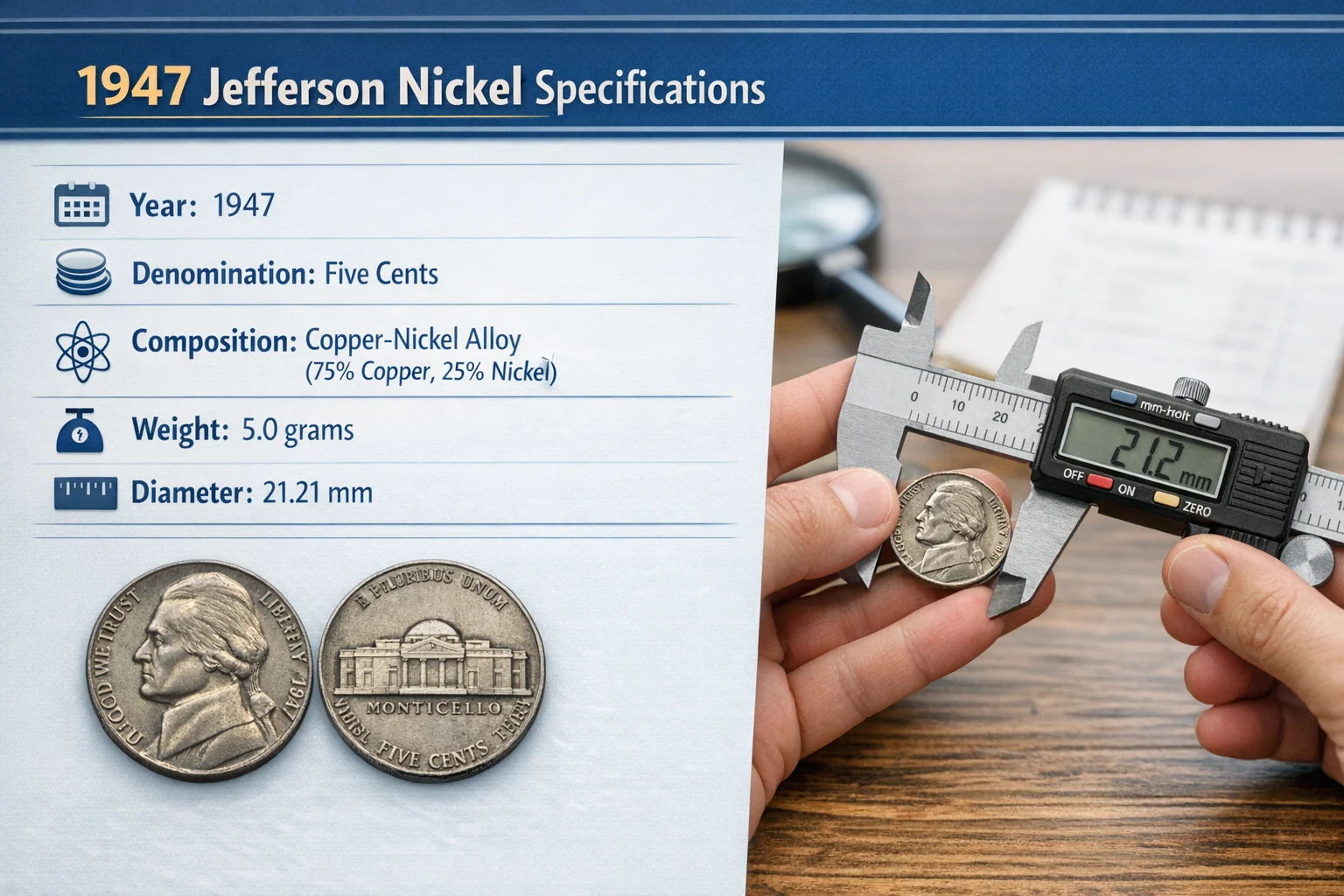
Diameter | 21.21 mm |
Edge | Plain |
Obverse | Thomas Jefferson |
Reverse | Monticello |
Intended use | General circulation |
Every genuine 1947 nickel should match these parameters. Weight and diameter help confirm authenticity. Composition explains why the coin has no melt value.
Large deviations usually point to damage, corrosion, or measurement error. They rarely mean rarity or a special issue.
What Really Determines the Value of a 1947 Nickel
The year alone does not make a coin expensive. Millions of 1947 nickels were struck. Supply remains high.
The main factors that affect price are:
Overall condition
Level of wear
Surface preservation
Current market demand
Metal content does not play a role, as all these nickels have no silver. Face value is fixed. Historical interest is moderate.
Collectors separate the circulation value from the collector value. For this issue, the collector value depends almost entirely on condition. A worn coin remains common, but a clean example becomes more desirable.
Demand stays stable. There are no sudden spikes. Prices move slowly over time.
Condition as the Primary Price Factor
Condition matters more than any other detail. This applies strongly to the 1947 nickel.
Most examples show wear in predictable areas. These areas include:
Jefferson’s cheek and jaw
Hair above the ear
Lettering near the rim
Steps of Monticello
Wear appears first on high points. As circulation continues, details flatten. Letters remain readable longer than portrait features.
Collectors must separate three things: circulation wear, weak strike, and post-mint damage.
Circulation wear produces smooth surfaces. Weak strikes show flat areas without metal flow. Damage creates scratches, dents, or unnatural marks.
Understanding the difference prevents overvaluation. Many beginners confuse weak details with minting flaws. In reality, wear explains most softness.
Good lighting can help more than magnification. Tilting the coin helps reveal the remaining relief.
Market Value by Grade
Prices in the table below are typical for standard coins. Please note that errors and special varieties are not included in the table.
Grade | Condition Description | Typical Price Range |
G–VG | Heavy wear, flat details | Face value – $0.20 |
F | Clear date, worn portrait | $0.20 – $0.40 |
VF | Moderate wear, strong lettering | $0.40 – $0.80 |
XF | Light wear, visible hair detail | $0.80 – $1.50 |
AU | Slight wear, traces of luster | $1.50 – $3 |
MS60–MS63 | Uncirculated, contact marks | $3 – $8 |
MS64–MS65 | Strong strike, luster | $8 – $25 |
MS66+ | Sharp details, high eye appeal | $40+ |
Price note: Market values change over time. Always check new data before buying or selling.
As you see, the jump between MS65 and MS66 is significant. Small surface differences matter at this level. Eye appeal also becomes critical, as fewer coins survive in top grades.
Common Mistakes When Estimating 1947 Nickel Value
Many people expect older coins to fall into the category of coins worth money. This expectation causes common errors.
One mistake is overvaluing the year. The date looks old, but supply remains high. Age alone does not create scarcity.
Another mistake is expecting a premium for wear. Heavy circulation reduces appeal. Wear does not add value.
Some confuse weak strikes with lost detail. A flat step or soft hairline often comes from use, not from production issues.
Others focus on history instead of condition. While history matters, buyers pay for preservation.
These mistakes still exist because of online claims and misleading listings. So, learn grading basics and reliable tools to avoid mistakes and check the main details. The best coin value app helps confirm basic details, check estimated value, and store information about coins at hand. But remember that the app cannot replace judgment. The final value always depends on the condition and demand.
Conclusion
The 1947 nickel is a common U.S. circulation coin. It is not rare. Its price depends on the condition.
Clean surfaces matter more than age. Sharp detail raises value. Wear lowers demand. The market remains stable.
In common, the 1947 nickel set realistic expectations: not every old coin is rare. The coin fills a slot without a high cost. It supports study rather than speculation.